The Panda Ant: Deceptive Black-and-White 'Ant' That's Actually a Wingless Wasp


Insect Information
The Panda Ant: Deceptive Black-and-White 'Ant' That's Actually a Wingless Wasp

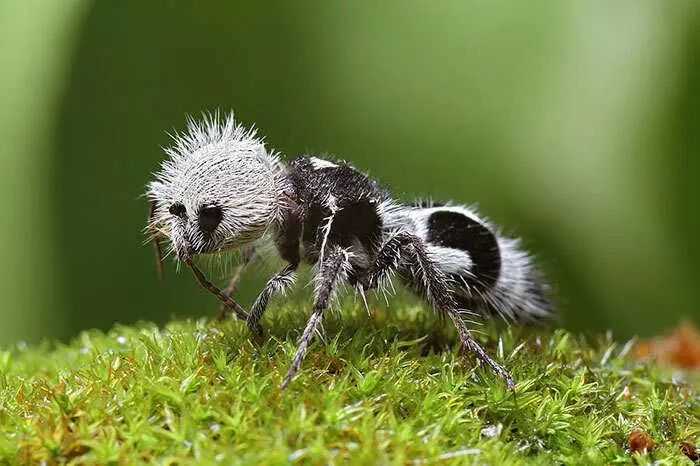
Despite its name and ant-like appearance, the panda ant (Myrmecopsis sp.) is a wingless wasp belonging to the family Mutillidae. Found in arid regions of Chile and parts of Argentina, this striking insect has captivated entomologists with its black-and-white coloration—a pattern that belies its true identity and hides a painful secret.


A Wasp in Ant's Clothing: Anatomy and Adaptations

  • Mimicry and Warning Coloration
    The panda ant’s body measures 8–10 mm, with a velvety black exoskeleton contrasted by white patches on its head, thorax, and abdomen. This bold pattern serves as aposematic coloration, warning predators of its potent sting. Females lack wings, resembling ants to blend into their environment, while males (rarely seen) have wings and a less dramatic color scheme.
  • Venomous Defense Mechanisms
    Despite its small size, the female possesses a powerful stinger, earning it the nickname "cow killer" in some regions (though its sting is not lethal to humans). The venom is designed to subdue prey and deter attackers, making it one of the most feared insects in its habitat.

Life Cycle and Ecological Role

  • Parasitic Reproductive Strategy
    Female panda ants are parasitic, laying their eggs in the nests of other ground-dwelling bees or wasps. Upon hatching, larvae feed on the host’s eggs and larvae, eventually pupating and emerging as adults. This behavior makes them important regulators of bee and wasp populations in arid ecosystems.
  • Nocturnal and Solitary Habits
    Active primarily at night, the panda ant forages for nectar and water. Its dense body hair helps it collect pollen, contributing to plant pollination despite its parasitic lifestyle. Due to its secretive nature, little is known about its mating behaviors or population dynamics.

Scientific Interest and Conservation Status

The panda ant’s unique morphology and life cycle have made it a subject of study for entomologists researching mimicry and parasitic evolution. Its presence in Chile’s arid zones also makes it an indicator of ecosystem health, though habitat destruction from agriculture and urbanization poses potential threats.


While not currently listed as endangered, the species’ reliance on specific host insects and arid habitats highlights its vulnerability to environmental changes. As with many lesser-known invertebrates, preserving the panda ant’s habitat remains crucial for maintaining biodiversity in Earth’s dryland ecosystems.


In the arid landscapes of South America, the panda ant stands as a testament to nature’s deceptive beauty. Its ant-like appearance and wasp-like biology remind us that in the insect world, looks can be profoundly misleading—and that even the most visually striking creatures may hide survival strategies as complex as they are surprising.

Latest Stories
Economic News1 minute readBritain’s construction sector showed mixed signals in June, with the Purchasing Managers’ Index (PMI) edging up to 48.8—its highest level in six months—yet still lingering below the 50 threshold that separates expansion from contraction. A stark divide emerged within the industry:
Economic News1 minute readAustralia’s benchmark S&P/ASX 200 inched up 0.02% to 8,590.7 on Tuesday, oscillating narrowly after the Reserve Bank’s surprise decision to hold rates steady triggered intraday dips. The index briefly turned negative in early trading but recovered modestly by close.
Social News1 minute readIn the Arabian Peninsula, where six out of seven nations boast a per capita gross national product exceeding $20,000—with Qatar soaring to $80,000—Yemen stands as a tragic outlier. By 2024, its per capita GDP plummeted to a meager $486. What led to such a vast economic chasm within the same region? The answer lies in Yemen's complex and troubled present.
Social News2 minute readMexican New Year celebrations blend vibrant symbolism with culinary heritage, creating a sensory experience of color, flavor, and renewal. Homes across the country transform into kaleidoscopic spaces, each hue carrying intentional meaning: red for love, yellow for career prosperity, and green for financial abundance. This decorative ritual, rooted in indigenous and Spanish traditions, turns living spaces into visual prayers for the year ahead.
Social News1 minute readIn the run-up to Christmas 1995, a Swedish woman lost her wedding ring while cooking. Despite searching everywhere, she couldn’t find it. Sixteen years later, in 2012, she pulled a carrot from her garden and discovered the ring stuck on it.
Industry News1 minute readReuters, citing sources and documents, reports that dozens of global health and water supply infrastructure projects have been halted after the U.S. terminated related aid. The news agency verified 21 stalled projects across 16 countries.
Life News1 minute readGENEVA, July 16 (Xinhua) -- Amid the lush pastures of the Alpine foothills, Switzerland's time-honored pastoral tradition has nurtured a world-renowned cheese culture, with Fondue standing as its most iconic treasure. This beloved dish, which perfectly blends melted cheese with bread, is not only a staple on Swiss tables but also carries the memory of unity in this multi-ethnic nation.