The Helmeted Turtle Ant: America’s Living Shield with a Disc - Shaped Head


Insect Information
The Helmeted Turtle Ant: America’s Living Shield with a Disc - Shaped Head

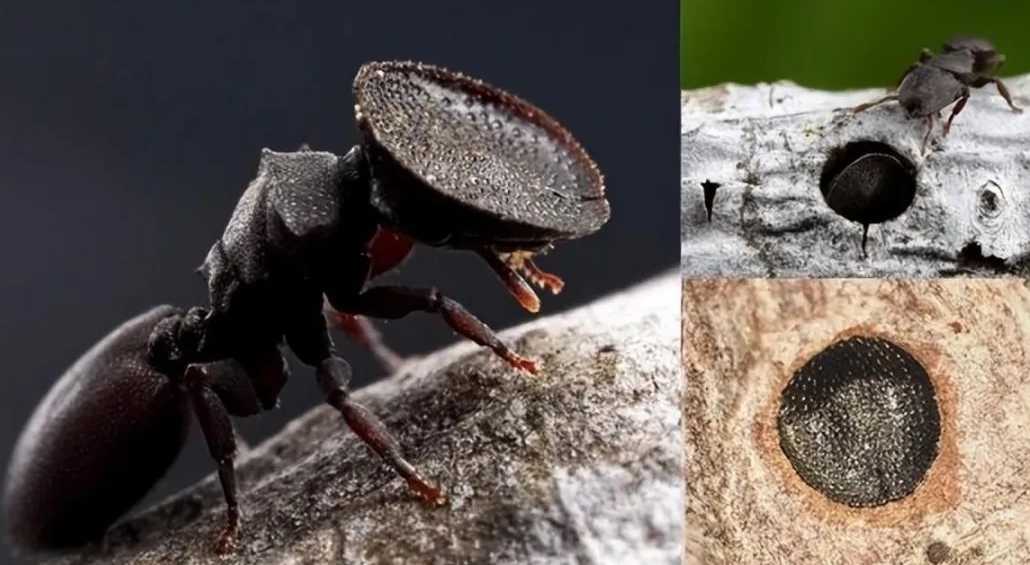
Native to the tropical forests of the Americas, the helmeted turtle ant (Cephalotes varians) is renowned for its flattened, disc - like head that resembles a natural shield. A member of the turtle ant genus, this species has evolved an extraordinary defense mechanism: when threatened, worker ants plug their nest entrances with their armored heads, acting as living barricades to fend off intruders.

Anatomy: A Head Built for Defense
  • The Natural Barricade
    The ant’s most distinctive feature is its broad, circular head, measuring up to 2 mm in diameter—precisely sized to seal the cylindrical entrances of their tree - trunk nests. The head’s rugged exoskeleton features ridges and grooves that interlock with the nest’s tunnel walls, creating a near - airtight seal.
  • Specialized Body Structure
    While workers sport enlarged heads, soldiers and queens have more typical ant anatomies. The ant’s elongated thorax and abdomen allow easy movement through narrow tunnels, while its legs are adapted for climbing, enabling quick retreats to the nest.

Defensive Behavior and Social Organization

  • Collective Nest Protection
    When predators (such as wasps or rival ant colonies) approach, turtle ants employ a coordinated defense strategy:
    1. Workers retreat into the nest tunnel tail - first.
    2. The last ant in line uses its shield - shaped head to block the entrance, with other ants bracing from behind.
    3. If needed, the ant secretes a sticky substance from its abdomen to reinforce the blockade.
  • Arboreal Colony Life
    These ants inhabit hollow tree trunks, feeding on nectar, sap, and small insects. They form medium - sized colonies with queens, workers, and soldiers, and rarely venture to the forest floor, spending most of their lives in the canopy.

Ecological Impact and Scientific Inspiration
  • Role in Forest Ecosystems
    By excavating tunnels in dead wood, turtle ants aid in forest decomposition and nutrient cycling. Their nests also provide shelter for other organisms, such as mites and beetles, that live in commensal relationships with the ants.
  • Biomimicry Applications
    Scientists study the ant’s head - plugging behavior for insights into adaptive engineering. The interlocking design of its head and nest entrance has inspired concepts for self - sealing robotic valves and emergency barrier systems.


In the rainforests of the Americas, the helmeted turtle ant exemplifies nature’s ingenuity. Its ability to transform its body into a living fortress showcases how evolution shapes both anatomy and behavior for survival—proving that even the smallest creatures hold valuable lessons in resilience and adaptive design.
Latest Stories
Economic News1 minute readBritain’s construction sector showed mixed signals in June, with the Purchasing Managers’ Index (PMI) edging up to 48.8—its highest level in six months—yet still lingering below the 50 threshold that separates expansion from contraction. A stark divide emerged within the industry:
Economic News1 minute readAustralia’s benchmark S&P/ASX 200 inched up 0.02% to 8,590.7 on Tuesday, oscillating narrowly after the Reserve Bank’s surprise decision to hold rates steady triggered intraday dips. The index briefly turned negative in early trading but recovered modestly by close.
Social News1 minute readIn the Arabian Peninsula, where six out of seven nations boast a per capita gross national product exceeding $20,000—with Qatar soaring to $80,000—Yemen stands as a tragic outlier. By 2024, its per capita GDP plummeted to a meager $486. What led to such a vast economic chasm within the same region? The answer lies in Yemen's complex and troubled present.
Social News2 minute readMexican New Year celebrations blend vibrant symbolism with culinary heritage, creating a sensory experience of color, flavor, and renewal. Homes across the country transform into kaleidoscopic spaces, each hue carrying intentional meaning: red for love, yellow for career prosperity, and green for financial abundance. This decorative ritual, rooted in indigenous and Spanish traditions, turns living spaces into visual prayers for the year ahead.
Social News1 minute readIn the run-up to Christmas 1995, a Swedish woman lost her wedding ring while cooking. Despite searching everywhere, she couldn’t find it. Sixteen years later, in 2012, she pulled a carrot from her garden and discovered the ring stuck on it.
Industry News1 minute readReuters, citing sources and documents, reports that dozens of global health and water supply infrastructure projects have been halted after the U.S. terminated related aid. The news agency verified 21 stalled projects across 16 countries.
Life News1 minute readGENEVA, July 16 (Xinhua) -- Amid the lush pastures of the Alpine foothills, Switzerland's time-honored pastoral tradition has nurtured a world-renowned cheese culture, with Fondue standing as its most iconic treasure. This beloved dish, which perfectly blends melted cheese with bread, is not only a staple on Swiss tables but also carries the memory of unity in this multi-ethnic nation.